The Constitutions of Myanmar: Failure to Address Grievances of Ethnic Minority Groups
Comparative Look at the three consitutions of Myanmar and their failure to address the grievances of ethnic minority groups in Myanmar

In this essay, I will examine the impact of political institutions on the ethnic conflict in Myanmar. Building on grievance literature in ethnic conflict, I hypothesize that the ethnic conflict in Myanmar is exacerbated by the failure of the government to address the grievances of ethnic minority actors in the political institution of their constitution. To examine this, I will survey the three constitutions of Myanmar and evaluate if they addresses the grievances of the ethnic minority
Grievances and Ethnic Conflict
I build my argument on the writing of grievance theory on ethnic conflict and civil war. Grievance theory holds that ethnic grievances build frustration amongst communities that ultimately leads to aggression and ethnic mobilization, such as ethnopolitical wars, peaceful protests, and violent rebellions (Shaykhutdinov and Bragg, 2011). In this context, a grievance is a deprivation of basic needs or an unfulfilled claim of certain rights for a group based on their identity; it is often equated with relative deprivation (Zartman, 2005). I argue that the constitutions of Myanmar fail to address the grievances of the ethnic minorities through its (1) deprivation of the ethnic minority groups of political rights and (2) failure to address their historical claims to political autonomy. I analyze the constitutions of Myanmar in a historical fashion, examining the provisions and the extent to which they address the grievances of both the majority ethnic group and the minority ethnic group. First, the 1947 Constitution denied the ethnic minority groups of the rights promised through the Panglong Agreement, offering minimal autonomy and denying the ethnic minority groups federalism. Second, the 1974 Constitution denied the ethnic minority groups the political representation offered to the ethnic minority groups in the 1947 Constitution and implemented discriminatory policies. Finally, the 2008 Constitution denied the ethnic minority groups political autonomy and, through its implementation of a democratic process, further aggravates grievances, as ethnic minority groups face increased discrimination in democratic elections.
Political Conflict in Myanmar
Political Conflicts
In order to understand the underlying grievances and how the constitutions of Myanmar may or may not address them, we must first understand the underlying political conflicts of the state. Two conflicts characterize the political environment of Myanmar: (1) how the people relate to the political leaders and state power and (2) how state power from the central government relates with the peripheral territories (Kramer, 2015). For the purpose of this essay, I will refer to them as the democratization conflict and the centralization conflict. These two conflicts are separate but occasionally intersect, as those engaging in these political conflicts often have intersecting interests and grievances.
Democratization Conflict
The process of democratization in Myanmar coincided with the process of decolonization. The first legislative election was held in Myanmar in 1947, prior to its official independence from British colonial rule in January 1948 (Aktar, 2020). Following independence, democracy was established through the 1947 Constitution and upheld, with three parliamentary elections occurring between 1948 and 1958. However, in 1958, General Ne Win established a military “caretaker government” in Myanmar and called for rule by martial law, eventually staging a coup in 1962 and establishing one-party authoritarian rule by the military (Maizland, 2021). Since the 1962 military coup d’état, the democratization conflict has consisted of the military actors (Tatmadaw) fighting to maintain state power while the non-military political parties and general public have been advocating for democratic, multi-party elections. The democratization conflict primarily manifests through conflict between the Tatmadaw and the general public, or when available, a pro-democracy political party. This conflict is not inherently tied to ethnicity, as the actors in this conflict are primarily of the majority Bamar ethnicity. However, there are still actors of ethnic minority groups who advocate for democracy.
Centralization Conflict
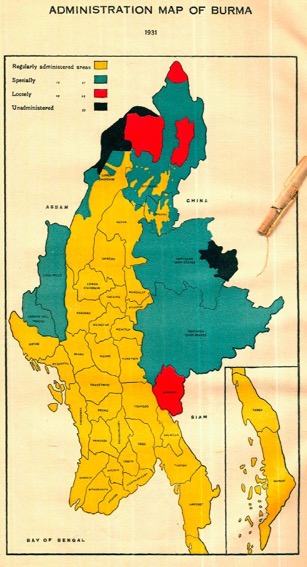
Prior to independence, Great Britain divided the territory now known as Myanmar into two administrative regions: the Regularly Administrated Burma and the Frontier Regions (Taylor, 2005). The Frontier Regions were either considered specially administered areas, loosely administered areas, or un-administered areas (Bennison, 1933). When Myanmar was granted independence from Great Britain, a major issue the new administration faced was the incorporation of the loosely administered and un-administered Frontier Regions with the Regularly Administrate Burma. This conflict primarily manifests between the government (mostly run by the Tatmadaw) and the ethnic minority groups.
Actors and Grievances
This section will briefly review the previous assignment on actors and their respective grievances and agenda. For the purpose of this assignment, I will categorize the major political actors into three primary categories. They may shift and may take on different names, but they are rooted in the same underlying agendas.
Tatmadaw and Military Proxy Groups
The armed forces of Myanmar, also called the Tatmadaw, has existed since Myanmar gained its independence. Over time, it collected influence and power over the country, eventually controlling the government around 10 years after Myanmar gained its independence. The Tatmadaw has embodied various political groups. The Tatmadaw has located itself at the centre of politics in Myanmar since 1958, and it continues to play a significant role. The primary agenda of the Tatmadaw and its affiliated political organizations is the maintenance of a centralized government under their control; this agenda purposefully minimizes the importance of ethnicity (Taylor, 2005). However, this increased centralization of power under the military also exacerbated conflict between pro-democracy groups and the Tatmadaw, as it denied any multi-party elections and essentially denied any form of liberal governance to the people.
Pro-Democracy Groups – Ethnic Majority Group
The pro-democracy groups are primarily divided into two actors: political and social. The social actors are the general public, which has been an adamant advocate for democracy. As democracy was established in the 1947 Constitution, the primary pro-democracy grievances did not arise until the 1962 coup d’état by General Ne Win. The pro-democracy population has mobilized through protests, such as the 8888 Protests and through political parties, once they were allowed. Formed in 1988, the National League for Democracy is a significant political party led by Aung San Suu Kyi, the daughter of Aung San (Maizland, 2021). The primary objective of this party is to advocate for increased democracy and liberalization in Myanmar. While this is a significant actor in political conflict in Myanmar, for the purpose of this essay, I will not address their grievances in relation to the Constitutions.
Ethnic Minority Groups
While the ethnic majority Bamar people comprise approximately 69% of the population of Myanmar, there are 135 recognized ethnic minority groups in Myanmar, which are further divided into 8 ethnic races: Bamar, Shan, Kachin, Chin, Rakhine, Mon, Kayah (also called Karenni), and Kayin (also called Karen) (Embassy of the Union of Myanmar, n.d.). Additionally, there are ethnic minority groups not recognized by the government and thus barred from citizenship. While these ethnic minority groups are diverse, they all share very similar grievances due to the colonial history of Myanmar and its political development after independence. Ethnic minority groups mobilize politically through ethnic political parties, which advocate for the right to greater autonomy for ethnic minority groups and their territories. These political parties may occasionally vary in regards to their, political ideology, but they all generally advocate for greater self-determination for their respective ethnic groups or for a federal system (Oh, 2020). The ethnic minority actors mobilize militarily through Ethnic Armed Organizations (EAOs). With some of these EAOs founded as early as 1948, they have been advocating for the right to autonomy and independence of their respective ethnic groups since the independence of Myanmar (Bynum, 2018). The primary grievances of ethnic minority groups in Myanmar are a lack of political influence, the lack of ethnic control over territory, marginalization and discrimination by the ethnic majority groups, and a lack of economic and social infrastructure. There is also a deep hatred for the Tatmadaw’s “Burmanization” policy, in which the military pursued the “Burmese Way to Socialism” through the repression of ethnic minority language, culture, and religion (Kramer, 2015). In response to these grievances, ethnic minority groups pursue an agenda of federalism or ethnofederalism, which often intersects with democratic ideology.
Constitutions
Myanmar’s present ethnic conflict is intimately connected to past efforts to end both the democratization conflict and the centralization conflict and how those attempts are codified in law and political institutions (Crouch, 2014). The primary political institution that addresses the allocation of state power is the constitution. I will survey the context and provisions of each constitution, concluding with an assessment of whether the constitution addressed the grievances of the party.
1947 Constitution
Context
When negotiating independence from Great Britain and the constitution of Myanmar, multiple rounds of conversations and negotiations took place in regards to how the ethnic minorities would be grafted into the new country. The most significant attempt to incorporate the ethnic minorities was the Panglong conferences in 1946 and 1947, which brought together General Aung San, the leader of the independence movement, with leaders of the Shan, Chin, Kachin, and Karen communities to discuss the future of the Frontier Regions with the respective ethnic leaders (Walton, 2008). The negotiations resulted in the Panglong Agreement, in which General Aung San agreed to offer a federal settlement which provided for full political autonomy and power sharing, as well as an offer of complete independence to the Chin and Shan States if the federalism in Myanmar failed after 2 years (Brenner and Schulman, 2019). However, just over five months after the Panglong Agreement, General Aung San was assassinated by ultranationalist paramilitaries; his political party rushed to finish a constitution without his lead, failing to incorporate the federal provisions in the constitution.
Provisions
The 1947 Constitution is rooted in a legal tradition of social democracy and parliamentary democracy (Myanmar Research Centre - Australia National University, 2021). It establishes a bicameral parliamentary system with multi-party elections. The Chamber of Deputies had 250 seats with the number of ministers based on population, while the Chamber of Nationalities had 125 seats allocated on the basis of ethnicity in proportion to population (“Constitution of the Union of Burma,” 1947). This structure allowed for political participation and representation for the ethnic minorities. The territorial division of Myanmar was asymmetrical, allocating five special territorial areas for the Shan, Kachin, Karen, Karenni, and Chin ethnic minorities; the constitution also provided the right of secession for the Federated Shan States and the Karenni State after 10 years (“Constitution of the Union of Burma,” 1947).
Grievances Addressed
While there was minimal political representation for ethnic minorities in the Chamber of Nationalities, the 1947 Constitution failed to address most of the agreements made in the Panglong Agreement. There were no provisions for federalism, as Aung San promised, and there was minimal autonomy designated to the ethnic minority groups. There have been calls amongst the ethnic minority communities for a “return to the spirit of the Panglong Agreement” and for increased federalism and regional autonomy (Walton, 2008). Following the 1947 Constitution, certain EAOs, such as the Karen National Liberation Army (KNLA) and the Pa-O National Army (PNA) formed to defend the interests of their respective ethnic minority groups. This escalated the tensions between the government and the ethnic minority groups, eventually resulting in armed insurgencies in Karen State, Karenni State, Shan State, and Kachin State. Following these insurgencies, the government slowly removed rights from ethnic minorities, namely constitutional amendments removing the right to secede from Karen State, reducing Karen representation in the Chamber of Nationalities by a third, and placing the Shan State under military administration and arresting the leaders of the Shan State Council (Crouch, 2015).
1974 Constitution
Context
Due to civil unrest, in 1958, President U Nu asked General Ne Win to create a “caretaker government” and impose martial law in Myanmar (Transnational Institute, 2017). This “caretaker government” was the first political evolution of the Tatmadaw. The Tatmadaw eventually returned the power of the government, with an election held in 1960. However, the General Ne Win and the Tatmadaw staged a coup d’état, enforcing martial law under the dictator General U Ne Win. Following a period of martial law, the Tatmadaw formed a government under single-party rule under the Burmese Socialist Programme Party (BSPP) (Maizland, 2021). He deemed the 1947 Constitution to be null and void. The primary political strategy under the BSPP was the “Burmese Way to Socialism” which centralized power under the military government; this thin veil of socialist ideology was paired with increased nationalism and an emphasis on law and order was codified under the 1974 Constitution (Crouch, 2014).
Provisions
The 1974 Constitution draws upon the legal tradition of socialism, borrowing from legal tradition with the USSR (Myanmar Research Centre - Australia National University, 2021). It was a highly unified and centralized system. The constitution created a single-party, unicameral parliament, called the People’s Assembly/Pyithu Hluttaw which had 489 seats. All members of parliament needed to have been members of the BSPP (“Constitution of the Union of Burma,” 1974). It divided the territory of Myanmar into seven divisions and seven states, which were based on ethnic minority. While there was territorial recognition of the ethnic minority groups, this territorial division did not offer the ethnic minority groups the autonomy they wished and refused to devolve powers to them or create any form of federal structure. The constitution also notably removed all parliamentary representation for ethnic minority groups and did not have the previous provisions of the right to secede for the Shan and Karenni states (“Constitution of the Union of Burma,” 1974).
Grievances Addressed
The 1974 constitution strictly controlled political activity of all groups: the ethnic majority Bamar people and the ethnic minorities. The 1974 Constitution removed the political representation offered to the ethnic minority groups by removing the Chamber of Nationalities and changed the territorial system from asymmetrical to symmetrical. While the 1974 Constitution created more ethnic states, the constitution did not allow for any powers devolved to the states, as all legislative power was held by the unicameral, single party socialist parliament (Crouch, 2015). The 1974 Constitution limited the political rights and representation of all people in Myanmar, but it continued to aggravate ethnic tensions by failing to address any grievances.
2008 Constitution
Context
Over the course of the rule of the BSPP, public tension against the BSPP grew until the 8888 Uprising occurred in 1988. Following this pro-democracy uprising, General Ne Win stepped down as dictator, and the BSPP was dissolved and replaced with the State Law and Order Council (SLORC) (Huang, 2013). The Tatmadaw dropped all pretence of ruling Myanmar as a Socialist country and declared that they would run Myanmar under martial law, essentially declaring the 1974 Constitution null and void (Crouch, 2014). In 1990, the SLORC allowed for the first multi-party election since 1960, and this election resulted in a landslide victory for the pro-democracy political party National League for Democracy (NLD) led by Aung San Suu Kyi. The Tatmadaw declared the election illegitimate, arresting the elected leaders apart from some hand-picked by the military (Crouch, 2020).
Provisions
The 2008 Constitution has no grounding in any particular legal tradition but rather draws on the influence of the 1947 Constitution, the 1974 Constitution, and the Tatmadaw ideology of the 1990’s (Crouch, 2019). Significantly, it returns to a bicameral parliamentary system, similar to that of the 1947 Constitution. There is a People’s Assembly/Pyithu Hluttaw with 440 seats; 330 seats are directly elected, and 110 seats are appointed by the Tatmadaw. Additionally it has a Chamber of Nationalities/Amyotha Hluttaw with 224 seats; 168 seats are directly elected, and 56 seats are appointed by the Tatmadaw (“Constitution of the Republic of the Union of Myanmar,” 2008). It is significant to note that the Chamber of Nationalities, while sharing the same name, is distinctly different from the Chamber of Nationalities in the 1947 Constitution and fails to offer ethnic minorities the same level of representation. Drawing from the socialist legal tradition in the 1974 Constitution, there is an emphasis of the duties of the citizens rather than the rights provided by the government (Myanmar Research Centre - Australia National University, 2021). The constitution also draws strongly upon the military ideology that rose in the 1990’s, centring the Tatmadaw in the political process; democracy is determined and evaluated by the military.
Grievances Addressed
This constitution significantly, incorporated democratic institutions and began the process of a slow liberalization. However, the constitution-making process for the 2008 Constitution was incredibly undemocratic, excluding any influences outside of the Tatmadaw (Crouch, 2020). Overall it fails to address the grievances and feeds into the narrative that the ethnic minority groups are failed by their government. First, it does not address any requests by the ethnic minority groups. While the 2008 Constitution offered limited political rights for ethnic minority groups, it has no provisions for federalism and refuses ethnic minority territories the right to secede (“Constitution of the Republic of the Union of Myanmar,” 2008). There are no provisions or promises for federal system, provisions which the ethnic minority leaders have expressed are crucial to them. Second, the democratic provisions fail to offer the ethnic minority groups adequate political representation and influence. The Chamber of Nationalities is distinctly different from the 1947 Chamber of Nationalities and does not ensure political representation to the ethnic minority groups as its predecessor did. While it is argued that the democratization progress in Myanmar should offer more ability for the ethnic minority groups to have political representation, it appears that the ethnic minority groups faced even more discrimination in the elections. Some ethnic minority groups faced discrimination in the elections either through partial election cancellation in their region or through bureaucratic measures. Ethnic minority groups that are not recognized by the government and are thus ineligible for citizenship, such as the Rohingya, could not vote at all (Lidauer, 2022). When no ethnic group had the right to vote, they all were equally discriminated against by the government. Now that the majority group has the right to vote, the discrimination against the ethnic minority groups is even more clear. The provisions of this constitution have exacerbated the grievances of the ethnic minority groups.
Conclusion
The constitutions of Myanmar have systemically denied the requests of the ethnic minority groups and have aggravated grievances in those communities. The Constitution of 1947 failed to provide for federalism, as promised by General Aung San in the Panglong Agreement, and following that constitution, political representation, political autonomy, and rights of the ethnic minorities have been gradually removed through both amendments and further constitutions. The 1974 Constitution removed the political representation offered to the ethnic minority groups by removing the Chamber of Nationalities and changed the territorial system from asymmetrical to symmetrical to minimize the importance of the ethnic minorities. The 2008 Constitution, while providing limited democratic institutions, such as ethnic political parties, fails to address the primary grievances of the ethnic minority groups by not incorporating a federal system and failing to provide political representation for the ethnic minority groups. While there is no current constitution in Myanmar, the ethnic conflict continues. EAOs continue to engage in armed clashes with the Tatmadaw and advocate for political autonomy. As the future of Myanmar unfolds following the 2021 coup d’état, the people of Myanmar wait to see what new political structure will determine the allocation of power in the country.
See the end of the page for a table comparing the three constitutions
Bibliography
Aktar, T. (2020) Democratic Election in Myanmar: Political Transition and Challenges. Asian Profile. 48 (1)
Anon (2008) Constitution of the Republic of the Union of Myanmar.
Anon (1947) Constitution of the Union of Burma.
Anon (1974) Constitution of the Union of Burma.
Bennison, J. J. (1933) “Burma, Part I. - Report,” in Census of India, 1931. Rangoon: Office of the Supdt. Government Printing and Stationary, Burma.
Brenner, D. & Schulman, S. (2019) Myanmar’s top-down transition: Challenges for civil society. IDS Bulletin. [Online] 50 (3), 17–36.
Bynum, E. (2018) Analysis of the FPNCC/Northern Alliance and Myanmar Conflict Dynamics. [online].
Crouch, M. (2020) Constitutional touchstones: Peace processes, federalism, and constitution-making in Myanmar. International Journal of Constitutional Law. [Online] 18 (4), 1350–1372.
Crouch, M. (2015) “Ethnic Rights and Constitutional Change,” in Andrew Harding (ed.) Constitutional Reform and Legal Change in Myanmar. Hart Publishing.
Crouch, M. (2019) The Constitution of Myanmar. [Online]. Hart Publishing.
Crouch, M. (2014) The Layers of Legal Development in Myanmar.
Embassy of the Union of Myanmar, B. (n.d.) Composition of the Different Ethnic Groups under the 8 Major National Ethnic Races in Myanmar [online].
Htung, Y. (2018) Armed Conflicts between the Kachin Independence Organization and Myanmar Army: A Conflict Analysis. Thammasat Review. [Online] 21 (2).
Huang, R. L. (2013) Re-thinking Myanmar’s political regime: military rule in Myanmar and implications for current reforms. Contemporary Politics. [Online] 19 (3), 247–261.
Kramer, T. (2015) Ethnic Conflict and Lands Rights in Myanmar . Social Research. 82 (2), 355–374. [online].
Kramer, T. (2017) The Current State of Counternarcotics Policy and Drug Reform Debates in Myanmar. Journal of Drug Policy Analysis 10 (1).
Lidauer, M. (2022) Boundary Making in Myanmar’s Electoral Process: Where elections do not take place. Modern Asian Studies. [Online] 56 (2), 533–566. [online].
Maizland, L. (2021) Myanmar’s Troubled History: Coups, Military Rule, and Ethnic Conflict | Council on Foreign Relations [online].
Myanmar Research Centre - Australia National University, 2021. The 2008 Constitution in 2021. Myanmar Musings.
Oh, S.-A. (2020) Parties and their Significance in the Myanmar 2020 General Election. [online].
Shaykhutdinov, R. & Bragg, B. (2011) Do grievances matter in ethnic conflict? An experimental approach. Analyses of Social Issues and Public Policy. [Online] 11 (1), 141–153.
Taylor, R. H. (2005) Do states make nations? The politics of identity in Myanmar revisited. Source: South East Asia Research. 13 (3), 261–286.
Transnational Institute (2017) Beyond Panglong: Myanmar’s National Peace and Reform Dilemma.
Walton, M. J. (2008) Ethnicity, conflict, and history in Burma: The myths of Panglong. Asian Survey. [Online] 48 (6), 889–910.
Zartman, I. W. (2005) Greed and Grievance: Methodological and Epistemological Underpinnings of the Debate.
Image Source: Myint-U, T (2018) 9 October. Available here
Constitutions of Myanmar
| Constiution | Parliamentary Structure | Elections | Territorial | Secession Rights | Federal Provisions |
|---|---|---|---|---|---|
| 1947 | Bicameral: Chamber of Deputies and Chamber of Nationalities | Multi-Party | Assymmetrical Division: Five special territories based on Ethnic Minority | Shan and Karenni State could secede from the Union of Burma after 10 years | No Federal Provisions |
| 1974 | Unicameral | Single Party - Burmese Socialist Party | Symmetrical Division: All states are equal | No Secession Rights | No Federal Provisions |
| 2008 | Bicameral: People's Assembly and Chamber of Nationalities | Multi-Party - open to all parties following 2011 | Assymetrical Division: Seven Regions, Seven States, and Self-Administered Zones/Divisions based on ethnic minority groups with limited self-governance | No Secession Rights | No Federal Povisions |